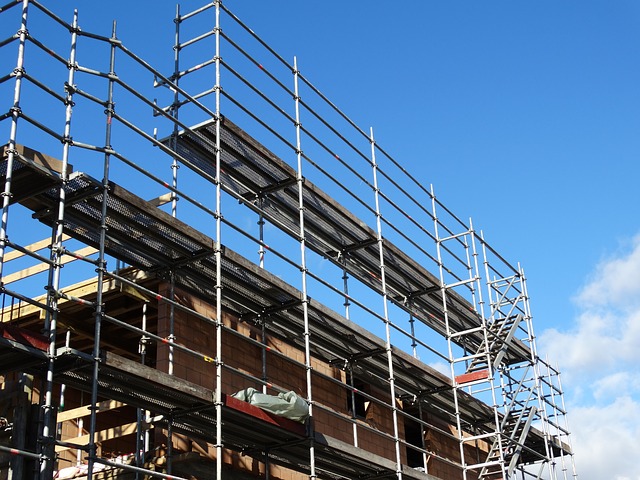
Single or Brick Layer Scaffolding Type- This type of scaffolding is typically used in the erection Dorset Scaffolding of brick walls. It is usually a temporary isolated framework set up parallel to the wall being erected, 1.2 metres from it. It consists of scaffolding parts- standards, ledgers and putlogs. A sequence of vertical members called standards made of timber or bamboo, fixed firmly into the ground and parallel to the wall being erected. They are placed at intervals of about 2- 2.5 metres. These vertical members are connected with the help of horizontal members called ledgers placed at intervals of 1.2- 1.5 metres. Putlogs are connected on ledgers using rope lashing at one end of the scaffolds while the other end is supported into the wall.
These putlogs are placed at intervals of 1.2- 1.5 metres. Braces are also fixed diagonally across standards to provide extra support and stability to the scaffolding parts when very tall structures are being constructed.
Double or Independent or Mason’s Scaffolding Type- This is also known as mason’s scaffolding or stone masonry scaffolding because it is generally used for stone masonry works. It is much stronger than single scaffold types and provides better support for construction processes. Unlike single scaffolding materials which consist of a single framework, mason’s scaffolding consists of two rows of standards separated by ledgers to improve the stability of the scaffold as it stands independent and does not require any support from the structural component being constructed. To improve the strength and durability of the ledgers, transforms are placed on ledgers with cross-braces.
This attribute makes it stronger than single scaffolding. The two rows of standards are set up in such a way that the first row is fixed near the wall, at a distance of 20-30 cm from the wall while the second row is fixed slightly farther from the wall, 1.5 metres from the wall. The double in its name is due to two rows of standards penetrating the ground surface. Putlogs, when used in double scaffolding, are not supported into the wall instead, they are supported at both the ends of the scaffolding parts which eliminates the dependence of scaffolding materials on the walls.
Steel or Tubular Scaffolding Type- This looks similar to mason’s scaffold type where the bamboo or timber members have been replaced with steel and sometimes, can also serve the purpose of a brick layer’s scaffolding when holes are made into walls to support one end of the scaffolding. It is also known as tubular scaffolding due to the use of hollow steel tubes in place of timber or bamboo planks, with diameter in the range of 1.5- 2.5 inches. Instead of using rope lashing for the fastening of members, special types of steel couples are used which consist of individual pipes, bolts, nuts, washers, wedges and clips held together by prop nuts.
The steel standards are connected using tube ledgers placed at intervals of 1.8 metres. The putlogs used in this scaffold type are quite long, generally 1.2- 1.8 metres long. The only drawback of using steel scaffolds is that it is comparatively more expensive but the advantages are numerous, some of which have been given below-
The entire framework of steel scaffoldings can be dismantled and erected much quickly than timber or bamboo scaffold types.
It is much more durable than its counterparts, thus has a long life and is more cost-effective than others.
One of the crucial advantages of using steel scaffold type is that it is far more fire-resistant than its counterparts.
And last but not least it is much stronger and sturdier which allows it to be used for high elevation construction works.
Cantilever or Needle Scaffolding Type- This scaffold type consists of a framework that has standards supported by a series of needles taken out through holes in the walls or strutted inside the floors through openings.
The one in which the needles are taken out from the walls are called single frame type or dependent cantilever scaffolding and the one in which the needles are strutted inside walls are called independent or double frame type cantilever scaffolding. This scaffold type is used in situations such as the ground being weak to support standards when construction work is to be performed at higher elevations, and the space near the walls need to be kept vacant for traffic and walkways.
System Scaffolding Type- Also known as Modular Scaffolding, this scaffold type is primarily made up of prefabricated vertical and horizontal members or components that can be effortlessly connected systematically. It is likely the most used scaffold type in the world for massive construction projects. This type of scaffolding can be easily be erected since the positions of connections are fixed and the entire framework only needs to be fastened at these locations. System scaffold types come in large varieties and some of the most popular types have been given below-
a.) Cuplock or Ringlock Scaffolding System- Cuplock scaffolding system is a heavy-duty scaffolding system that can support heavy loads and is made from galvanized steel. This scaffolding type is popular all over the world because it has a unique and simple locking mechanism, it is very easy to set up, and it is fast and economical. Highly standardized systems can be created with cuplock scaffolding type for scaffolding designs with repeated patterns.
A cuplock scaffolding system consists of standards, ledgers, transoms and base plates. The ledgers have a blade at both ends and the standards have locking cups placed throughout its length at intervals of 500- 1000 mm. The standards and ledgers are available in several lengths and are connected through the pre-engineered locking cups.
b.) Kwikstage Scaffolding System- This scaffolding system is quite similar to the cuplock scaffolding system and the components used in its framework are standards, ledgers, basic jacks, and hook-on boards. The only difference is that instead of a cuplock system or locking cups, V-shaped fittings are used here to which the ledgers are connected. The transoms secure the scaffolding system and link the inner and outer standards through these V-shaped fittings. Also, when on-slip platforms and double guard rails are used with Kwikstage scaffolds, the safety and reliability of the system are improved.
c.) Staircase Tower or Haki Scaffolding System- Staircase tower scaffolding is used to make the main scaffolding platform accessible as it is safer than using ladders. For small works, this scaffold type is useful in working independently from its platform where workers can carry tools and equipment with them up the stairs which is safer than climbing ladders.
This scaffold type can also be used to temporarily access high elevations in a structure in case of urgency. This system has fewer components and is lighter in terms of safety, quality and adaptability than other systems. One of the most contemporary systems, staircase tower scaffolding is not only used in scaffolding but also shoring and suspended systems.
 Site Title
Leave a comment